New Analysis of Unit 3 Fuel Pool Video Reveals Top of Fuel Bundle

About This Video

A video first released by TEPCO in April has been re-analyzed by Ian Goddard and appears to reveal a handle found atop a single nuclear fuel bundle. This raises more questions about the condition of any fuel still remaining in the Unit 3 fuel pool.

Video Transcript

[tabgroup][tab title="English"]

Arnie Gundersen: Hi I'm Arnie Gundersen from Fairewinds.

If you have been watching the site lately, it has been about 3 weeks since we have updated a video.  During that time, Maggie and I have been on the road making a couple of presentations in Massachusetts, a couple of TV shows and some radio and print.  That will be on the site over the next couple of weeks to inform you of what we have been up to.  But something happened last night that I really wanted to share with you right now.

I got an email last night from Ian Goddard.  And Ian is a long time watcher of this site and has done some really great analysis in the past as well.  He took a look at an old TEPCO video.  And Tokyo Electric had gone into the Unit 3 fuel pool just once.  You remember that Unit 3 is the reactor that is blown to smithereens.  The video showed a lot of damage.  But Ian Goddard was able to find one spot where there is clearly something that appears to be discernible.  It looks like the handle of a BWR fuel bundle.

Ian compares that bundle to other bundles which were looked at over in Unit 4 and it is pretty clear to me and a couple of other nuclear engineers I have shown it to, that this might be a single nuclear fuel bundle in the Unit 3 fuel pool.

It raises more questions than it answers.  First of all, there should be a lot of bundles there.  Yet, obviously, there is only one in this picture.   Where are the other bundles?  The other part of the question is, this should be under about 25 feet of water.  It is not, it is very near to the surface.  So what has happened to that particular bundle, or to the water level in the pool that caused it to come in such close contact with atmosphere?

Like I said, it raises more questions than it answers, but I really do want to thank Ian Goddard for discovering this.  If you have any comments or questions or thoughts on what you think it might be, please send in through the comments section on the website.

Thanks, we will get back to you soon.

[/tab][tab title="日本人"]

3号機使用済み燃料プールのビデオの再分析で、燃料集合体の上部を発見

東京電力が4月に公表したビデオをイアン・ゴダード氏が再分析した結果、1つの燃料集合体の上に付いているハンドルが確認できるようです。3号機の使用済み燃料プールにまだ残っている燃料があるとすれば、それは現在どのような状態になっているのか、より謎が深まりました。


こんにちは。フェアウィンズのアーニー・ガンダーセンです。ここ3週間ほど更新しておりませんでしたが、その間マギーと私はマサチューセッツでの講 演やテレビ、ラジオの出演、執筆などをこなしながら家を離れていたのです。この模様や経過を2,3週間の内に皆様にお見せできると思います。しかし、今日 は昨夜起きたことをぜひ皆様にお伝えしたいと思ったのです。 昨夜イアン・ゴッダードさんからメールをもらいました。イアンさんはフェアウィンズのサイトに以前から注目してくれ、すばらしい分析もしています。彼は以前公開 された東電のビデオを再度検討したそうです。東電は一度だけ3号機の使用済み燃料プールを撮影しています。思い出してください。3号機は爆発でめちゃくちゃになった原子炉です。ビデオには多くのダメージが映っていました。イア ン・ゴッダードはその中に一箇所だけ、形がはっきり分かるものを見つけたのです。それは沸騰水型原子炉用の燃料集合体の取っ手のように見えます。

イアンはその取っ手と4号機の燃料プールに映し出されていた燃料集合体の取っ手を見比べてみました。ほかの何人かの核の専門家にも見せてみましたが、私にもそれは3号機の使用済み燃料プールに残っている燃料集合体のように思えるのです。 答えよりも疑問の方が多くなってしまいます。まず、燃料集合体はたくさんあるはずです。しかし、明らかに映像には一体しか映っていません。ほかの集合体はどこへ行ったのでしょう?もうひとつ、燃料集合体は水面から25フィート(7.6m)ほど下にあるはずです。しかし、この燃料集合体はそうではありません、ほとんど水面に近いのです。一体ここに映っているこの燃料集合体に何が起きたのか、または使用済み燃料プールの水位に何が起きたのか。結果としてこの燃料集合体が大気にほとんど触れる位置になっています。

というように、答えよりも疑問の方が多くなってしまいましたが、これを発見したイアン・ゴッダードさんに大変感謝したいと思います。みなさんのご意見、質問、ご感想などありましたら、サイトのコメントに残してください。それではまた、近いうちにお会いしましょう。

[/tab][/tabgroup]

Gundersen Discusses the Situation at the flooded Ft. Calhoun and Cooper Nuclear Power Plants.

Fairewinds-Energy-Flooded-Ft-Calhoun-and-Cooper-Nuclear-Power-Plants-.jpg

https://vimeo.com/25833682

About This Video

Gundersen says "sandbags and nuclear power shouldn't be put in the same sentence, but it is a lot better than Fukushima." Gundersen explains that Ft. Calhoun was already shut down and has much less decay heat. He stresses that the auxiliary building and containment building are not his major concern. A small building, the intake structure, which contains the emergency service water pumps is needed for cooling the nuclear fuel and should be protected. Another Nuclear Plant, Cooper (about 90 miles south of Ft. Calhoun), is still running and poses a bigger threat because of it's decay heat. Gundersen believes that both Nuclear Plants will "ride out" this problem, as long as an upstream dam does not break. If an upstream dam were to break, he says, "All bets are off".

 Video Transcript

YELLIN: Let's get some perspective now on the safety of nuclear power plants in the U.S. and look at some possible worst case scenarios.

We're joined by nuclear safety advocate Arnie Gundersen. Arnie, the Nuclear Regulatory Commission says the situation at Ft. Calhoun is under control, that this will not be a repeat of what we saw in Japan. In your view, case closed?

ARNIE GUNDERSEN, NUCLEAR SAFETY ADVOCATE: Well, sandbags and nuclear power shouldn't be put in the same sentence, but it is a lot better than Fukushima. The real reason why is, they were shut down in April and their management decided not to start them back up.

Now, nuclear atoms split, and these split pieces give off a lot of heat. But after two months, there's not anywhere near as much heat.

So, to compare it to Fukushima is wrong. It's a real problem, but it's not a Fukushima level problem at all.

YELLIN: We're looking at pictures right now -- I don't know if you can see them. But when you take a look, are you already concerned about the emergency pumps possibly flooding? I mean, they are covered in water. What happens after that?

GUNDERSEN: Well, I think the focus has been on those two big buildings. The auxiliary building and the containment. Really, it's not those buildings I'm concerned about.

There's a little building out by the water and it's called the intake structure. And in there is an emergency service water pump. That's the pump that cools the nuclear fuel. So, it's important that that building not flood any more because if the emergency service pumps get flooded, they won't be able to cool that nuclear reactor.

YELLIN: OK. Now, Ft. Calhoun as you point out, it's been shut down since April. Then there's Cooper Nuclear Plant, which is about 90 miles south of Ft. Calhoun, it's a different story.

So, why are you more concerned about Cooper?

GUNDERSEN: Well, Cooper's still running, and again, those pieces -- if Cooper were to shut down now, the heat produced would be 100 times more than the heat at Ft. Calhoun, a lot more heat to get rid of.

Now, it's also the identical reactor to Fukushima. It's a boiling water reactor, just like it.

If I were the management of Cooper, I'd really think about shutting down so that you get ahead of the problem, so that there's less of those decayed products to generate heat.

YELLIN: Do you have any immediate concern for the people who are living nearby?

GUNDERSEN: You know, short of an upstream dam failure, I think they'll ride this one out. If an upstream dam were to fail, all bets are off. So, I think the key is to keep an eye on the upstream dams.

YELLIN: Now, if you were consulting a team at Ft. Calhoun and Cooper right now, what advice would you give them?

GUNDERSEN: Well, Ft. Calhoun, you know, they got taken to the woodshed about 18 months ago and have made a lot of modification since. Now, why the NRC waited 30 years to do that is a question.

But, right now, with the modifications they've made and being shut down for two months, I don't really think they can do much more except wait and hope the water doesn't get high.

Down at Cooper, though, my advice would be to shut down now and ride it out.

YELLIN: All right. Arnie Gundersen, thank you so much. Let's hope all goes well there and continues as it has.

GUNDERSEN: Thanks for having me.

Gundersen Discusses Ft. Calhoun Situation

Gundersen says "sandbags and nuclear power shouldn't be put in the same sentence, but it is a lot better than Fukushima." Gundersen explains that Ft. Calhoun was already shut down and has much less decay heat. He stresses that the auxiliary building and containment building are not his major concern. A small building, the intake structure, which contains the emergency service water pumps is needed for cooling the nuclear fuel and should be protected. Another Nuclear Plant, Cooper (about 90 miles south of Ft. Calhoun), is still running and poses a bigger threat because of it's decay heat. Gundersen believes that both Nuclear Plants will "ride out" this problem, as long as an upstream dam does not break. It an upstream dam were to break, he says, "All bets are off".

WBAI's Robert Knight discusses the ongoing situation at the flooded Ft. Calhoun nuclear plant with Fairewinds' Arnie Gundersen.

Duxbury Emergency Management Hosts Independent Nuclear Expert Panel

Duxbury Emergency Management Hosts Independent Nuclear Expert Panel

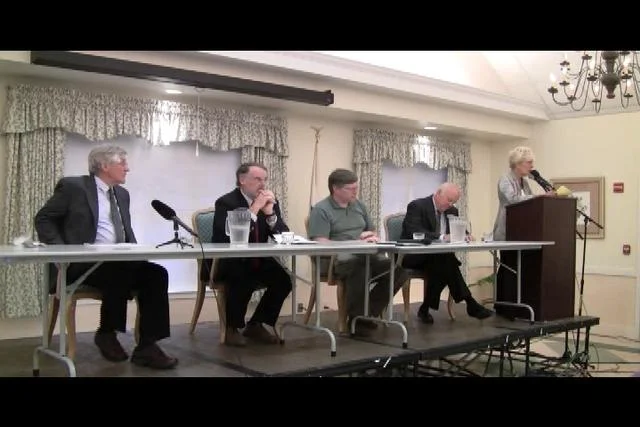
June 15th Duxbury Masachusetts Emergency Management Agency and the Duxbury Nuclear Advisory Committee forum entitled "Can Fukushima Happen Here?" and posted it for you to view. Arnie Gundersen of Fairewinds Energy Education was among four of the nation's leading independent nuclear experts invited to participate on the panel.

Read More

Hot Particles From Japan to Seattle Virtually Undetectable when Inhaled or Swallowed

Fairewinds-Energy-Hot-Particles-From-Japan-To-Seattle.jpg

https://vimeo.com/25002205

About This Video

Original estimates of xenon and krypton releases remain the same, but a TEPCO recalculation shows dramatic increases in the release of hot particles. This confirms the results of air filter monitoring by independent scientists. Fairewinds' Arnie Gundersen explains how hot particles may react in mammals while escaping traditional detection. Reports of a metallic taste in the mouth, such as those now being reported in Japan and on the west coast, are a telltale sign of radiation exposure.

Video Transcript

[tabgroup][tab title="English"]

Arnie Gundersen: Hi I'm Arnie Gundersen from Fairewinds.

There has been a lot of discussion in the press in the last week about Tokyo Electric changing their estimate for the amount of radiation that was released at Fukushima, and there has also been a lot of discussion about radioactive hot particles being discovered all over Japan.  I wanted to tie those two together today and talk about just what that means.

First, Tokyo Electric recalculated the amount of radiation that came out of Fukushima in the first week.  And they discovered that that first week released twice as much radiation as they had thought was released in the entire accident.  So it released an enormous amount more than they anticipated.

But the second piece of that, is that most of these new numbers, most of these new radiation particles, were hot particles.  And here is why.  Right after a nuclear fuel melts, it releases all of it's gasses and those gasses are called Xenon and Krypton.  They are noble gasses, they don't react and they surround the population, bombard the population, with gamma rays.  Now that part of the calculation is pretty straightforward.  That part doesn't change with this new estimate from Tokyo Electric.

So the Xenon and Krypton part of the estimate is there.  But what has changed is that they have realized that an enormous amount more hot particles were released.  Now even then, this is an assumption, remember all of the radiation detectors were blown to smithereens.  And still they are assuming that about 98% of the radiation is still inside that reactor.  But this new radiation is in the form of hot particles.  What are they?  Cesium, Strontium, Plutonium, Uranium, Cobalt 60 and many, many others.  When you go outside and you are in a cloud of noble gasses, you could pick it up with a radiation detector, because you are bombarded by gamma rays.

But when you are in hot particles, unless there are many, many, many, it is very difficult to detect a single hot particle.  But that doesn't mean it is not dangerous.  We are discovering by scientists, independent scientists, using air filters in Japan, that the average person in tokyo breathed in about ten of these hot particles every day all the way through the month of April.  Those same scientists, using air filters, are discovering that in Fukushima, people were probably breathing in 30 or 40 times more radiation than they were in Tokyo, again in the form of a hot particle.  What surprised me is that the air filters in Seattle, indicate that the people there were absorbing 5 hot particles every day for the month of April.  What does that mean?  It means that that hot particle gets absorbed in your lung, or it winds up in your intestines or it winds up in your muscle or it winds up in your bone.  It constantly bombards a very narrow piece of tissue.  Now we have here a picture of a lung from an ape and there is a hot particle in the lung.  And you can see how localized the damage is from that hot particle constantly bombarding the ape's lung.  Now a constant irritant like that your body fights, and most of the time your body wins.  Sometimes however, those hot particles can cause a cancer and of course, that is a grave concern.  Now you can't run a geiger counter over someone's lung on the outside to determine if they have a hot particle.  Because those particles, those rays, don't travel outside the body.  They do their damage to the local tissue.  But we know they are there, because the air filter results indicate that they are.

Since I was about 16 years old, I used to work on cars a lot.  I know that if I was working on a car in Japan right now, I would be using gloves and a respirator if I was removing the air filter in a car, because I know that there is radiation on those air filters.  That is what the independent scientists are telling us.

The last thing I would like to talk about tonight is that there have been reports coming out of Japan, of individuals tasting a metallic taste.  Now this is not the first time that that metallic taste has been detected after a nuclear accident.  People near Three Mile Island detected a metallic taste in their mouth.  People near Chernobyl detected a metallic taste in their mouth.  Also, patients undergoing radiation therapy for cancers also have detected a metallic taste in their mouth.  This is anecdotal.  It is very difficult to measure, but that we are seeing it in Japan confirms what has already been detected at Three Mile Island and at Chernobyl.

That's about it for tonight.  Next week, on Thursday, June 16th, I will be at the Boston Public Library between 6 o'clock and 8 o'clock at night.  The topic is:  Fukushima - Can It Happen Here In The United States?  I will be with David Lockbaum from the Union of Concerned Scientists and Dr. Richard Clapp, an epidemiologist.  If you are in the Massachusetts area, it would be nice to meet you there.

Thank you and I will keep in touch.

[/tab][tab title="日本人"]

 日本からシアトルに飛んできたホットパーティクル(放射性を持った粒子)は、吸い込んでも飲みこんでもほとんど検出不可能

キセノンとクリプトンの放出の、元の見積もりでは同じ数値に留まっているものの、TEPCO(東京電力)の再計算は、ホットパーティクル(放射性を持った粒子)の放出量について、劇的な増加を示しています。 このことは、独立系科学者により行われた空気フィルターの観測の結果からも確実になっています。フェアウィンズのアーニー・ガンダ-ソン氏は、既存の検出システムで検出されないホットパーティクル(放射性を持った粒子)が、哺乳類に対してどのように反応するであろうかを説明しています。現在、日本あるいは西海岸で報告されているような口腔内金属性テストの報告が、放射能被曝を明確に示すひとつの証拠なのです。


こんにちは、フェアウィンズのアーニー・ガンダーセンです。東京電力が福島第一原発から放出された放射線量の推計値を修正したために、先週はメディアで 様々な議論がなされました。また、高放射能粒子が日本全国で発見され、これも大きな議論を呼んでいます。今日はこの2つの出来事を結びつけ、その意味するところをお話ししたいと思います。

まず、東電は事故後一週間で放出された放射線の総量を計算し直し、当初予想していた量の二倍だったことに気づきました。予想をはるかに超える膨大な量が放出されていたわけです。

しかし、新しく増えた分のほとんどはホット・パーティクルと呼ばれる高放射能粒子です。なぜそうなったかというと、核燃料は融けるとすぐに気体状の放射性物 質をすべて放出します。この気体はキセノンとクリプトンで、希ガスと呼ばれる種類であり、ほかの物質と反応することはありません。気体は住民の周囲を取り巻き、住民にガンマ線を浴びせます。この希ガスの放出量に関しては計算が単純なので、東電の新たな推計値でも変化はありません。では何が変わったのかといえば、放出された高放射能粒子の量が予想をはるかに上回っていたことに気づいたのです。

事故の際に放射線計がすべて粉々に吹き飛ばされたのを思い出してください。それでも彼らは、放射性物質の約98%はまだ原子炉内に留まっていると想定していました。しかし、今回新たに判明した放射性物質は高放射能粒子という形態をとっています。具体的にいうと、セシウム、ストロンチウム、プルトニウム、ウラン、コバルト60などで、ほかにもたくさんの種類があります。

人が屋外に出て希ガスの雲に入った場合は、放射線計で探知することができます。希ガスが浴びせるのはガンマ線だからです。 ところが、高放射性粒子の中に入った場合、粒子の数がよほど多くないかぎり一個一個の粒子を検出するのは非常に困難です。検出されないからといって危険性 が低いわけではありません。独立機関の研究者が日本の車のエアフィルターを調べたところ、東京の平均的な都民は4月中、毎日約10個の高放射能粒子を吸い 込んでいたことがわかりました。同じ研究者によれば、福島県民は東京都民の30~40倍の高放射能粒子を吸い込んでいると見られています。

私 が驚いたのは、アメリカ西海岸のシアトルのエアフィルターからも、住民が4月のあいだ毎日約5個の高放射能粒子を体内に取り込んでいたとわかったことで す。これはどういう意味でしょうか。高放射能粒子が最終的に肺に入ったり、腸に入ったり、筋肉に入ったり、骨に入ったりする、ということです。体内に取り込まれた高放射能粒子は、非常に狭い範囲の体組織に絶え間なく放射線を浴びせます。

これはサルの肺の写真です。肺に高放射能粒子が入り込 んでいます。高放射能粒子がサルの肺に絶え間なく放射線を浴びせた結果、非常に局所的な損傷が生じていることに注目してください。絶えず組織を刺激する物 質が存在すると、体は戦います。たいていは体が勝つのですが、ときに高放射能粒子ががんを引き起こすことがあります。そうなればもちろん非常に憂慮すべき事態です。

体の外側から肺の上にガイガーカウンターをかざしても、体内に高放射能粒子が取り込まれているかどうかはわかりません。高放射 能粒子が出す放射線は体の外には出ないからです。ただひたすら体内組織の狭い範囲にダメージを与えます。それでもエアフィルターの調査から見て、体内に取り込まれているのは確かです。

私は16歳くらいの頃から、よく車の修理をしました。ですが、もしも今私が日本で車の修理をするとしたら、車のエアフィルターを取り外すときに手袋をはめてガスマスクをつけるでしょう。そのフィルターに放射性物質が付着しているのがわかっているからです。それ が独立機関の研究者たちの調査結果です。

最後にお話ししたいのは、「口の中に金属の味がする」という報告が日本から届いている点です。原 発事故のあとで金属の味が確認されるのは今回が初めてではありません。スリーマイル島原発の近隣住民も[事故後に]金属の味を感じ、チェルノブイリ原発の 近隣住民も金属の味を感じました。また、がんの放射線治療を受けた患者も金属の味を感じます。これは経験談なので科学的に測定するのはきわめて難しいので すが、今回日本で金属の味が報告されたことによって、スリーマイル島やチェルノブイリでの経験談が事実だったことが裏づけられたと思います。

では今夜はこの辺で。来週の木曜日、6月13日に、私はボストン公立図書館で午後6時から8時まで講演を行ないます。テーマは「福島の事故はアメリカでも起こりうるのか」です。私のほかに、「憂慮する科学者同盟」(Union of Concerned Scientists) のデビッド・ロックバウム博士や、疫学者のリチャード・クラップ博士も参加します。もし皆さんがマサチューセッツ近辺にいらっしゃるなら、お越しいただければ幸いです。

ありがとうございました。またお目にかかりましょう。

[/tab][/tabgroup]

Gundersen Discusses Level 4 Emergency Declared at the Ft. Calhoun Nuclear Plant in Nebraska

About This Interview

"Five O'Clock Shadow" with Robert Knight: On June 6, 2011, the Fort Calhoun pressurized water nuclear reactor 20 miles north of Omaha, Nebraska entered emergency status due to imminent flooding from the Missouri River. A day later, there was an electrical fire requiring plant evacuation. Then, on June 8th, NRC event reports confirmed the fire resulted in the loss of cooling for the reactor's spent fuel pool. The discussion includes specific details of the technical failures at Fort Calhoun, the risks of coolant loss at overcrowded "spent" fuel pools, and the national hazards of nuclear facilities along the Missouri and Mississippi Rivers, and other water sites during the current period of floods and climate change.

Transcript

Robert Knight Radio Show, in early June 2011, Part 1 of 3

Announcer: Well today OPPD declares a notification of unusal events at the Fort Calhoun Nuclear Power Station. OPPD did not want KMTV Action 3 News to shoot this video. But because the Missouri River is a public waterway, we feel it is our job and our right to show the

public what is happening at the Fort Calhoun Nuclear Power Station.

Water in many places already up to the buildings, with the flood expected to rise another 5 feet or more this summer. And we are told no release of radioactive material has happened or is expected.

Robert Knight: This is 5 o’clock Shadow on the Pacifica Radio Network. I’m Robert Knight in New York. We continue today our coverage of developing events at the Fort Calhoun Nuclear Power Plant in Nebraska, just north of the major city of Omaha. During our last report, it was revealed that there had been a Level 4 emergency declared at the plant because of the imminence of flooding from the Missouri River. The Army Corps of Engineers advised that the height of the river would be reaching, or soon exceeding, 1,004 feet above median sea level. And in that interval, the plant was required to go into emergency operations to defend and protect against flooding, of which there have been problems in the past at that plant with leakage passageways at the junctions of walls and of pipes and other related items.

During our last report, yet more news came in that during the day, there was a fire, an electrical fire, in a basement of that nuclear power plant, that caused an evacuation of the plant from approximately 9:30 or 9:40 a.m. local time until after 1 p.m., approximately 1:30 p.m. local time.

During that time, part of the plant was rendered inaccessible because of poisonous gasses and gasses that were used to extinguish the electrical fire. It gets even worse. We now know that the systems that were incapacitated by that fire at this nuclear power plant called Fort Calhoun in Nebraska . . . It had been shut down for refueling, but this electrical fire incapacitated parts of the cooling system for the spent fuel pool. Listeners might recall that one of the great hazards at Fukushima is the tremendously over the fact spent fuel pool at unit #4.

This is an important story and we are honored to have with us one of the most prominent experts on these issues, Arnie Gundersen, a former nuclear power plant operator and Chief Advisor for Fairewinds Associates. Arnie Gundersen, what is the latest you know about what is going on and what has happened and been minimized in the reportage generally about the situation at Fort Calhoun?

Arnie Gundersen: Thank you for having me. Your summary was really excellent. The sandbags and nuclear power plants really do not belong in the same sentence and now we are seeing one that is literally putting sandbags up to reinforce themselves against the

flood. I think the real issue here is why are we having the flood?

There is a lot of snow in the Rockies this year, more so than a long time, and all of the dams upstream are full. So all of them are just opening up their water and letting it cascade down to the next dam, which is letting it cascade down to the next dam.

The plant was designed against a flood. It cannot get much worse than this or else it is going to breech the walls. But my concern is, what if the dam breaks? That would be the equivalent of the Fukushima tsunami. These dams are filled to the brim and there is more than one, so it doesn’t mean that the one that is immediately upstream has to break, it is any one of the series has to break, which could inundate this like Fukushima was with essentially an inland tsunami. The dams are not structurally sound or built to the same standards as the nuclear plant, but in fact, the nuke plant is now relying on the integrity of something that is basically a big earthen berm.

Robert Knight: If one of these almost like an electrical circuit in series, resistors in series, if these dams, which we might liken to resistors, any one of them broke, that would put extra stress on all the ones downstream of it, would it not?

Arnie Gundersen: That is correct. It will probably ride out the storm if the storm doesn’t get any worse. They are within a foot or two of what they were designed for and hopefully, it looks like at the flows that are coming out of the dams as the Corps of Engineers has opened the valves, they can just barely get by. But if Mother Nature throws us a knuckle ball here, all bets are off.

Robert Knight: We have seen reports that the water is already treading on the edges and the walls of this nuclear power plant.

There was a television station near the nuclear power site that, despite the admonitions of the nuclear power company because the Missouri River is a public waterway, went boating up to the edge of the plant and saw it at the jeapardy of the encroaching water, 1,004 feet above sea level going up and the Weather Service and the Army Corps of Engineers says that it is expected to do nothing but rise until well into the summer of this year 2011.

Generically speaking, Arnie Gundersen, plant operator and advisor on nuclear issues for Fairewinds Associates, what is wrong with water in a nuclear power plant? What are the hazards in the basement?

Arnie Gundersen: There is safety related equipment that when the nuclear chain reaction stops and this plant is shut down, it was shut down in April for a routine refueling, and then they said, oh my god we got this flood coming, we better NOT start it back up. It was scheduled to be running by now. But even though it is shut down, there still is an enormous amount of heat left over from the particles that are left behind called radioactive “daughter” products. And we have seen that at Fukushima. The plant is still steaming because of all of that residual heat, called decay heat.

You have got to get rid of that, even after you have shut down the plant and so there are pumps, like the ones that failed last night, that are required to run for months, even years, after the plant is shut down, to keep the nuclear core cool. And of course the concern last night was that two pumps failed in the fire, not the nuclear core, it remained cooled through a different set of pumps, but the pumps that failed last night didn’t cool the fuel pool, so the fuel pool began to get hot. They recovered the pumps and the fuel pool cooled back down again. We all have Fukushima in our minds. Units 4 and Unit’s 3 fuel pool are sitting there smoldering, right on the edge of boiling, and normally these things should be at roughly 60 or 70 degrees. So they are not designed to boil in a nuclear fuel pool.

Robert Knight: In the process of refueling this Fort Calhoun Nuclear Power Plant, does the main assembly, the nuclear pile, does it stay inside the reactor, or is the whole assembly moved to a spent fuel pool? Where is the fuel, I understand that about one third of it, one third of the columns of uranium and perhaps other oxides, were to have been taken out and replaced. Where is that stuff? Is it in the reactor or in the spent fuel pool and what would you estimate to be the capacity of radioactive materials in the pool? And as a follow up to that, Arnie Gundersen, does heating tempt the process of zircaloy hydrogenization?

Arnie Gundersen: There was one third of the nuclear core that has been removed and is in the fuel pool, along with many other nuclear cores. There is 20 years or more worth of nuclear cores in the fuel pool. That is on the pumps that failed last night. So that that generates an enormous amount of heat. The closest example that I could tell you is Fukushima 4, which you recall the pictures of steam just pouring out of that fuel pool. Without water, that fuel pool would boil dry in several days.

Well, the NRC’s position is that you don’t need to call that an emergency pump, because you have several days and you can always spray water in and things like that. The problem with that argument is, that as it is boiling, or approaching boiling, it releases an enormous amount of humidity and that wipes out all of the electrical wiring in the containment. So you don’t want to get anywhere near boiling, and I don’t know that the NRC really understands that issue yet.

The other issue of what is in the nuclear reactor, there is fresh fuel plus two thirds of the nuclear core and the pumps that cool the nuclear reactor, the NRC considers safety related. The pumps that cool the fuel pool, the NRC says are not. And those are in separate cooling systems. They were not involved in the fire last night. But the flood is encroaching on all of that wire. Unlike Fukushima, the diesels are high enough, so that as the flood comes up they will probably be able to retain diesel power. Unless there is a bigger wave from a dam collapse. I think that is the lesson here, that Mother Nature can throw things at us that we did not anticipate.

Let’s hope that a flood like the one we are seeing is as bad as it is going to get.

Robert Knight: This is 5 o’clock Shadow on the Pacifica Radio Network. I’m Robert Knight in New York and that’s Arnie Gunderson in Vermont.

Arnie, one of the beauties of this kind of listener sponsored broadcasting is that we can look in more depth than the superfficial ways in which much nuclear news is being covered if at all. In the past day and a half or so, most conventional press reports simply said well, there was no danger of the release of radiation and did NOT sufficiently, in our opinion, address the issue of the potential heating up of the spent fuel well, the loss of monitoring, or the loss of cooling sytems and such.

Because we have this opportunity, I’d like you, as a nuclear expert, to help us walk through the nuclear event reports from the Nuclear Regulatory Commission. As of the 7th of June 2011, there was not a report on that day of the electrical fire, after the flooding emergency was declared on the 6th of June.

However, today we now have some items from the NRC’s event reports, which, if anybody needs a frightening bedtime story, just read these each and every day. Arnie, I’d like to actually take some time to be very specific with you so you can translate this for our audience. OK?

Arnie Gundersen: OK, go ahead.

Robert Knight: This is the nuclear event report for the 8th of June, 2011 in regard to the Fort Calhoun Nuclear Power Plant. I’m going to read four segments seriatum. Beginning at about 9:30 Central Daylight Time, the licensee noted fire in the west switchgear room. The fire brigade responded and found a room filled with smoke but no active fire. Halon did discharge in the room. At 09:56 CDT, offsite assistance was called and Blair Fire Department responded to the site. Blair Fire Department confirmed no active fire in the switchgear room. All offsite power remained available as well as the emergency diesel generators if needed. The licensee is currently attempting to ventilate the room, a thorough inspection of the affected area, and determine the cause of the electrical thought will be facilitated once the room has been fully ventilated.

What is a switch gear room and what level of disorder was taking place at that time?

 

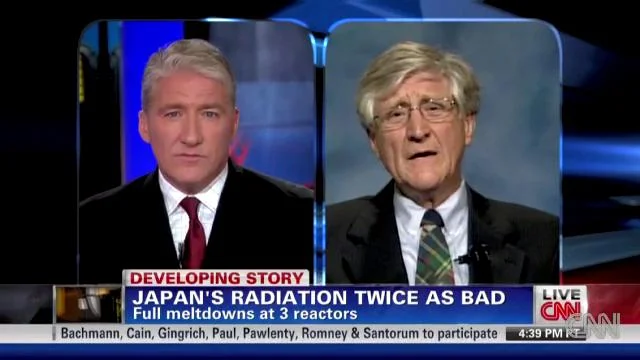
CNN's John King interviews Arnie Gundersen about the Hot Particles discovered in Japan and the US.

CNN's John King interviews Arnie Gundersen about the Hot Particles discovered in Japan and the US.

CNN's John King and Arnie Gundersen discuss "hot particles" detected in Seattle and Japan, the cozy relationship between Japanese regulator NISA (Nuclear and Industrial Safety Agency) and plant owner TEPCO, and changes at the Fukushima accident site since March.

Read More